What are Google Ads? “Google Ads is a digital advertising solution that helps you reach this audience and transform them into valuable customers”(Google Skill-shop).
Why do we need Google Ads? In order to grow your business, you need some sort of marketing and nowadays online marketing is best mode as more and more people use internet in their daily life. Google Ads provide technology for businesses to promote their businesses on various online platforms. “With Google Ads, you get access to a broad range of advertising products designed to help you reach customersin the moments that matter”(Google SkillShop).
How can Google Ads help in achieving Business goals?Drive Sales: Grow online, in-app, in-person, and over-the-phone sales. Get Leads: Boost conversions by encouraging people to take action. Increase website visits: get the right people to visit your website. Influence consideration: encourage people to explore your products and services. Build awareness: Reach a broad audience and maximize exposure. Promote your app: Increase installs and interactions with your app.
Google Ads are based on three main fundamentals principles:
1) Relevance: Google Ads helps you connect with the right people, at the right time, with the right message. Your ads can appear on Google Search, YouTube, and more, just when someone is looking for products or services like yours. You can also customize options, such as keywords and location, to get in front of the most relevant customers (Google SkillShop).
2) Control: Google Ads gives you complete control over your budget. You choose how much to spend per month, per day, and per ad. Based on your settings, Google Ads uses a lightning-fast auction to determine which ad to show. If you want to change your strategy, you can easily adjust your ad, modify your budget, or pause and restart a campaign (Google SkillShop).
3) Results: Pay only for results, like clicks to your website or calls to your business. Our measurement tools make it easy to see how your site, apps, and ads are performing. Plus, smart technology lets you create, manage, and optimize your campaigns so you can get the most out of your investment (Google SkillShop).
Google Ads Campaign: Businesses can be supported by making Google Ads Campaigns and there are 5 types of campaigns that google offers. These are Search, Display, Video, Shopping, and App. Each of these provides a specific objective and cab be choose to satisfy your business/marketing needs. Following is the link to google skill shop where you can find detailed information about all these 5 campaigns. https://skillshop.exceedlms.com/student/path/18163/activity/25485?skip_interstitial=true
What do users want? To get the most out of google ads, it is important to understand what uses or potential customers are looking for. There are three main things that people look for: Relevance information, Info based on their moment, and Ads that contribute to their experience.
Ad Extensions: There are numerous ad extensions available at Google that can add more value to your advertisement. These ad extensions are additional information that expand your ads to make them more valuable. There are various types of extensions such as universal site link extensions, Callout extensions, Structured snippets, Location extensions, Call extensions, Price extensions, Dynamic extensions etc.
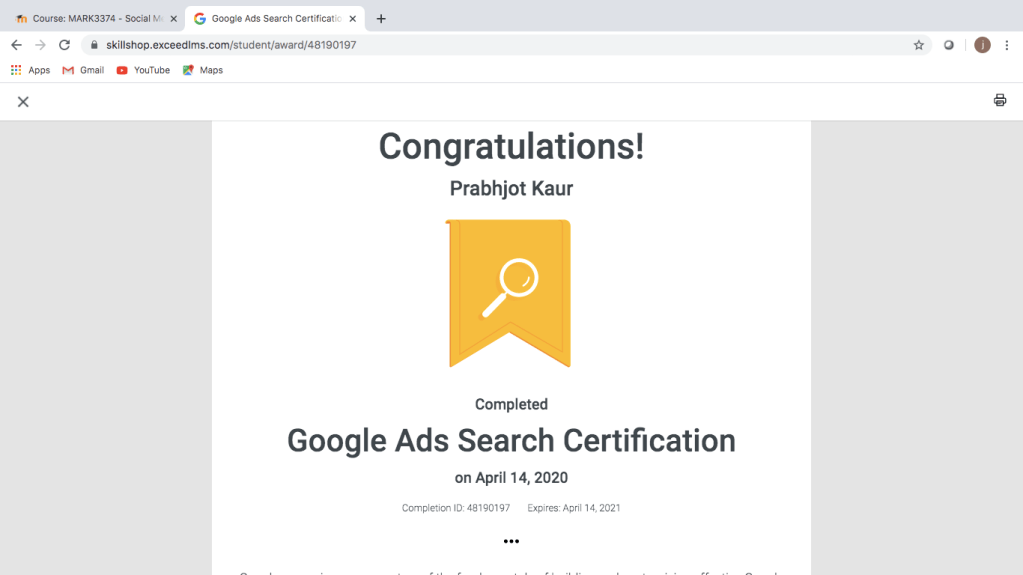
Conclusion: I have learned so many things through google skill workshop and got my certificate and below is the screenshot go that certificate. There is a lot more about google ads which is hard to summarize in this blog. I did not have any experience earlier with google ads however, now i have a better undersatnding of how these ads works and how business can get benefit from these. I am an accounting student however if i get a change in future to work with marketing department of an organization i would definitely apply this new knowledge there.
“Social media is a Business strategy” (Gil, 2019). It is important to that what networks to join, when to post, how you measure success should be tied to business objectives. If you want to make your business successful then be strategic and make data informed decisions accordingly. One of the Important take away from this LinkedIn learning video is What metrics to use on social media such as Facebook, Instagram, YouTube and twitter. It includes content, community, consistency and conversion and what roles these play in social media marketing (Gil, 2019).
Align Social Media and Business Strategies – Aligning social media and business strategies is crucial for businesses nowadays to reach out to customers and understand their purchasing behaviour. For this to happen businesses need to figure out the following first:
Where are your customers on social media such as Facebook, Instagram, or other platforms?
What are your competitors doing or not doing?
What is your purpose for being on social media? To drive customer acquisition and leads, brand awareness, customer service, or talent acquisition?
Four Pillars of a Social Media Strategy
Content- What users see from your brand on social media. Community- The users who regularly consume and engages with your content Consistency- How often you post determines how often you appear in user’s news feeds Conversion- The actions users take when they engage with your brand: click, comment, or share (Gil, 2019).
What Metrics You Should Measure: When businesses market themselves on social media they look for the following measurements on their posts:
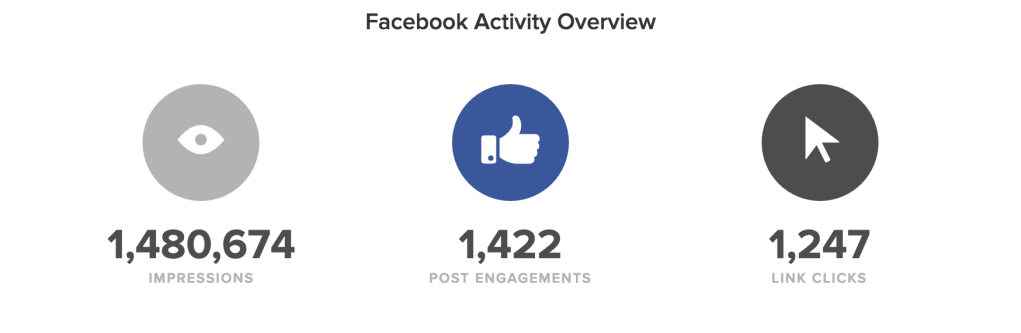
Impressions- Impressions are the number of times your content appears in the news feed.
Engagements- The number of times people interacted with your content. This is of more value then impressions.
Views- The number of times people see your video content
Clicks- The number of times people visit your website from a social media post. This is the most valuable metric.
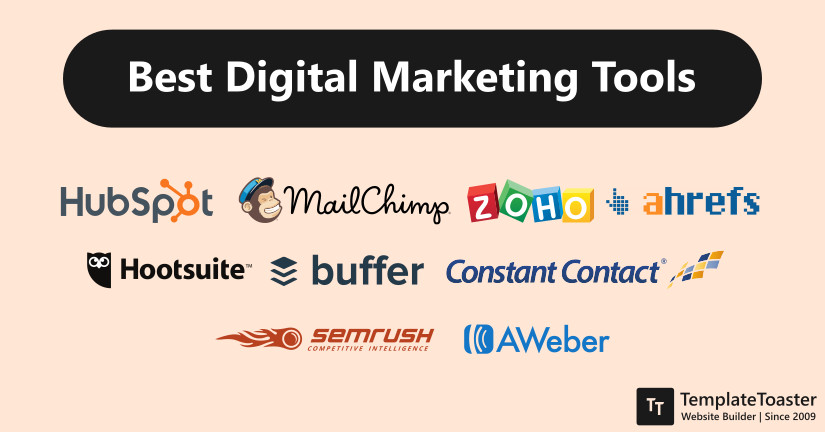
Tools to Measure ROI: These tools vary according to the size of the organization. Following are some examples of free and premium tools:
Buffer
Hootsuite
Sprout Social
Agorapulse
BuzzSumo
Keyhole
NetBase
Brand24
TubeBuddy
Rival IQ
Decoding Social Media Analytics: In the video by Gill, he mentioned different platforms such as Facebook, Twitter, LinkedIn, Youtube, and Instagram. There are some points to track Facebook insights such as reach, impressions, and engagement. According to Gil, (2019), this data can be exported to excel sheet and needs to be checked weekly. Facebook can also be a place for you to set up a store. You can add a product and give a price, description and the link to take the customer to your website to buy the product (Gil, 2019).
Instagram measures ROI by likes, comments, shares, followers, and bookmarks. As any social media platform, the more consistent you post the better analytical responses there will be and if you are posting more, your company will start appearing in hashtags which will help you reach an even larger number of people.
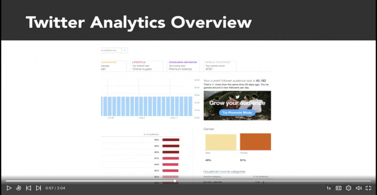
Twitter is a search engine that updates in real time. Businesses can detect the keywords and phrases used by their target audience. This will allow the company to become more relevant to their consumers. Top mentions, followers, and content are main insights of twitter. Following is an image/screenshot from the video about Twitter analytics.
Driving Measurable ROI on Each Channel
Facebook ad options to drive new customer Acquisition Facebook page has the option to promote your business. You need to make some selections such as objective, location, etc.(Gil, 2019).
Run Targeted Ads: Run targeted ads based on their location, age-range, and location. You can also customize your ad’s visuals.
Lead Generation Form: In B2B and service based business, you can collect lead forms directly from your Facebook page. Age, demographics, locations, and interests are important factor to collect (Gil, 2019).
Leverage Facebook Insights: Under posts option, you can sort through your best performing posts based on reach, comments, engagement, and clicks. As a growth hack you can revive or reengage old posts to bring them back to life by commenting or liking your old posts (Gil, 2019).
Facebook Ecommerce Integration
Set up your Store
Promote your products
Boost products posts to reach more users
Create engaging Instagram content based on Analytics
Quality content is not measured exclusively in likes.
Breaking down Instagram analytics.
Shares and bookmarks mean more than a like.
Use polls to generate sales leads.
Get content ideas through the questions features.
Formula for YouTube Monetization
YouTube requires 1000+ subscribers to monetize
Create a list of 12-15 tutorials or how-to videos to act as anchor videos
Title your new videos with keywords such as “tips”, “How to” and “the best”.
Retitle existing videos for improved search optimization.
Bonus Strategies for Maximizing ROI
Increasing website visits using Twitter Cards: To increase website views eye catching visuals are required along with catchy and inviting URL title. “A Twitter card is content designed to give users a rich media experience whenever tweets contain links to a site’s content. Twitter has various card types to show content previews, play video and increase traffic to sites” (Twitter Card).
When to Use Twitter Cards: Twitter Cards can be used while posting blogs, Youtube videos, and for special offers and promotions.
Drive Sales with Instagram stories: Following are the keys for Storytelling-
Keep them short
Have a beginning, middle, and end
What’s the call to action?
How to be Seen by Local Instagram
Create visually appealing content
Post often
Tell short stories through captions
Tag locations in your posts and stories
Embed content on your blog
Writing Short and engaging posts: following are the tips to write posts on instagram.
One to two sentences in length
Lead with an open-ended question whenever possible
Refrain from using calls to cation
Don’t post a link in the caption
Conclusion
Social media is critical for businesses nowadays and it is important to align your business strategy with the customers on social media. I am not a marketing student thus not really have any personal experience with companies using social media tools. However, I know have a better understanding of its important for businesses. For me, one of the Important take away from this LinkedIn learning video is What metrics to use on social media such as Facebook, Instagram, YouTube and twitter. It includes content, community, consistency and conversion and what roles these play in social media marketing.
In this video by Megan Adams (2018), “Social Media Marketing: Social CRM” I got to learn about social CRM fundamentals- Adding Social CRM to your strategy
(Malczan, 2019)
In this video by Megan Adams (2018), “Social Media Marketing: Social CRM” I got to learn about social CRM fundamentals- Adding Social CRM to your strategy
(Malczan, 2019)
All the information is collected from the social media sources and uses CRM analytical tools in the strategy
1) Marketing- Social listening to learn about your online audience’s behavior, i.e. sproutsocial.com
2) Sales- Understand where prospects are online and what they’re discussing
3) Customer service and support- Real-time, multi-channel support
4) Customer experience- Understanding what your customers’ needs and wants are and creating an exceptional, unique experience for them.
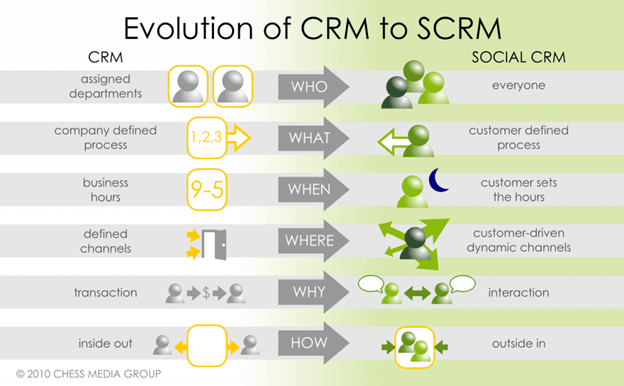
Traditional CRM and social CRM are combining as customers spend more time online and on different social media channels like Facebook, LinkedIn, Instagram, and Twitter. Following is a picture showing the evolution of Traditional CRM to Social CRM.
(Malczan, 2019)
Budget
Invest in growth
Use analytics to drive business case
Benefit to sales, marketing, and customer support
Work with your Social CRM provide
Key Takeaway:Work with the customers that love your brand by giving them a voice and a platform.
Connect Your Content with Prospects
Social Media
Allows prospects to investigate on own time, with no sales pitch
Provide exceptional value
Get Started
What is Social CRM? It is a strategy supported by social media, online tools, and technology that enables organizations to better engage with their customers. It helps to create a culture of advocacy, empowering your customer to shape their own experience with your organization. The right strategy and set of social CRM tools will help your organization use all of this social information to establish meaningful and transparent relationships with your customers (Adams, 2018).
How does it work?
Social CRM applies to marketing, customer service, support, and your organizational sales engagement.
Social CRM creates better and more powerful social engagement.
Social customer service.
24/7 service
Customers choose preferred mode of communication.
Tracks social media and online activity of prospects and customers.
Provides a full picture of interaction and engagement with your organization.
Allows you to act faster, individualize customer experiences, and anticipate their needs.
Examples:
Asks question on Twitter
Leaves Yelp review
Sends Facebook message
Begins online chat with customers service agent.
The new way of marketing CRM is used for tracking, measuring, and analyzing behavior over social landscape is becoming more difficult. According to traditional CRM, it build systems for customers to interact with whereas new social CRM build systems that allows customers to choose the way they interact with the organization (Adams, 2018).
Benefits of Social CRM
More meaningful engagement
Creation of brand advocates
Collection of important data
Helps construct brand’s image and conversations online.
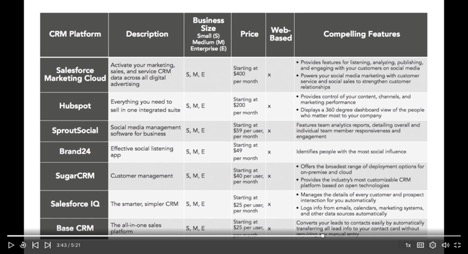
Choose a social CRM platform A social CRM platform gives your organization all the tools it needs to grow, all in one central location. There are 3 main reasons to use a social CRM platform (Adams, 2018).
Sales- looking to automate and boost sales
Marketing – Looking to streamline finding and engaging with customers and prospects
Customer service and support- Looking to deliver outstanding and responsive customer support.
What to look for in a Social CRM Platform
Business size
Ease of use
Features: sales, marketing, customer support
Integrations
Total cost, including setup fees and additions of users
Security features
Customers support: 24/7, email, phone
CRM Platform must have following elements to it:
Support for social media platforms that your organization is using
Brand monitoring
Social CRM analytics
Integration with your other platforms or services
(Adams, 2018)
Choosing a Platform after shortlisting few platforms
Take them for a test drive
Sign up for a live demo or free trial
Allocating Resources: Your social CRM success will depend upon organizational support and allocation of resources
Leadership Support:
Top-level support and buy-in.
Identify decision makers and influencers.
Making your business case.
Organizational strategy and culture
Ensure alignment with organizational strategy and goals.
Consider the implications: Change in culture, process, and technology
Build your Social CRM Team
Staff your social CRM team with early adopters
Determine the roles and required headcount
Invest in your social team
Training
Look to your social CRM provider for training opportunities
Direct resources to new initiatives
Support your social CRM team
Monitor and Evolve
Monitor social CRM activities
Additional support may be required
Evaluate the performance of the social CRM platform and strategy
Develop Your Strategy
(Puri, 2015)
Branding – a social and effective social CRM strategy builds an organization’s brand while creating fans and brand ambassadors. A brand is an overall impression resulting from communication and marketing methods of a product or company that distinguishes it form competitors.
Brand Includes:
Personality and persona
Examples: Starbucks and burger King
It has two factors – Humanization and personalization
Humanization- It includes having an easy to connect with personality versus being a faceless entity.
People connect with people
Join in on the conversation people are having about your brand
Example: Zappos service
Personalization- it includes allowing customer sot choose and shape their own experience with your brand.
Allowing customers to choose how they experience your brand
Example: Pandora
Tracking Brand Consistency
Track your brand’s sentiment across all social platforms
See how your messaging is resonating with your intended audience
Supporting your Customers
Determine value in all social media conversations with customers, leads, and brand advocates
Collaborate with customers and fans
Social Media Optimization
Integrate your social platforms with marketing, sales, and customer service
Cohesive campaigns
360-degree view
Rules of Engagement Laying out clearly defined rules will set the standard for every prospect and customer interaction. Defined rules of engagement gets your organization on the same page in all of their social CRM activities while invoking trust and transparency on the customer side (Adams, 2018).
Tone and personality
Set response to specific situations
Personalized responses
Guidelines for communicating company-wide announcements
Communicate How to be Reached
All the information is collected from the social media sources and uses CRM analytical tools in the strategy
1) Marketing- Social listening to learn about your online audience’s behavior, i.e. sproutsocial.com
2) Sales- Understand where prospects are online and what they’re discussing
3) Customer service and support- Real-time, multi-channel support
4) Customer experience- Understanding what your customers’ needs and wants are and creating an exceptional, unique experience for them.
Traditional CRM and social CRM are combining as customers spend more time online and on different social media channels like Facebook, LinkedIn, Instagram, and Twitter. Following is a picture showing the evolution of Traditional CRM to Social CRM.
(Malczan, 2019)
Budget
Invest in growth
Use analytics to drive business case
Benefit to sales, marketing, and customer support
Work with your Social CRM provide
Key Takeaway:Work with the customers that love your brand by giving them a voice and a platform.
Connect Your Content with Prospects
Social Media
Allows prospects to investigate on own time, with no sales pitch
Provide exceptional value
Get Started
What is Social CRM? It is a strategy supported by social media, online tools, and technology that enables organizations to better engage with their customers. It helps to create a culture of advocacy, empowering your customer to shape their own experience with your organization. The right strategy and set of social CRM tools will help your organization use all of this social information to establish meaningful and transparent relationships with your customers (Adams, 2018).
How does it work?
Social CRM applies to marketing, customer service, support, and your organizational sales engagement.
Social CRM creates better and more powerful social engagement.
Social customer service.
24/7 service
Customers choose preferred mode of communication.
Tracks social media and online activity of prospects and customers.
Provides a full picture of interaction and engagement with your organization.
Allows you to act faster, individualize customer experiences, and anticipate their needs.
Examples:
Asks question on Twitter
Leaves Yelp review
Sends Facebook message
Begins online chat with customers service agent.
The new way of marketing CRM is used for tracking, measuring, and analyzing behavior over social landscape is becoming more difficult. According to traditional CRM, it build systems for customers to interact with whereas new social CRM build systems that allows customers to choose the way they interact with the organization.
Benefits of Social CRM
(Plaksij, 2020)
More meaningful engagement
Creation of brand advocates
Collection of important data
Helps construct brand’s image and conversations online.
Choose a social CRM platform A social CRM platform gives your organization all the tools it needs to grow, all in one central location. There are 3 main reasons to use a social CRM platform
Sales- looking to automate and boost sales
Marketing – Looking to streamline finding and engaging with customers and prospects
Customer service and support- Looking to deliver outstanding and responsive customer support.
What to look for in a Social CRM Platform
Business size
Ease of use
Features: sales, marketing, customer support
Integrations
Total cost, including setup fees and additions of users
Security features
Customers support: 24/7, email, phone
CRM Platform must have following elements to it:
Support for social media platforms that your organization is using
Brand monitoring
Social CRM analytics
Integration with your other platforms or services
(Adams, 2018)
Choosing a Platform after shortlisting few platforms
Take them for a test drive
Sign up for a live demo or free trial
Allocating Resources: Your social CRM success will depend upon organizational support and allocation of resources
Leadership Support:
Top-level support and buy-in.
Identify decision makers and influencers.
Making your business case.
Organizational strategy and culture
Ensure alignment with organizational strategy and goals.
Consider the implications: Change in culture, process, and technology
Build your Social CRM Team
Staff your social CRM team with early adopters
Determine the roles and required headcount
Invest in your social team
Training
Look to your social CRM provider for training opportunities
Direct resources to new initiatives
Support your social CRM team
Monitor and Evolve
Monitor social CRM activities
Additional support may be required
Evaluate the performance of the social CRM platform and strategy
Develop Your Strategy
(Puri, 2015)
Branding – a social and effective social CRM strategy builds an organization’s brand while creating fans and brand ambassadors. A brand is an overall impression resulting from communication and marketing methods of a product or company that distinguishes it form competitors (Adams, 2018).
Brand Includes:
Personality and persona
Examples: Starbucks and burger King
It has two factors – Humanization and personalization
Humanization- It includes having an easy to connect with personality versus being a faceless entity.
People connect with people
Join in on the conversation people are having about your brand
Example: Zappos service
Personalization- it includes allowing customer sot choose and shape their own experience with your brand.
Allowing customers to choose how they experience your brand
Example: Pandora
Tracking Brand Consistency
Track your brand’s sentiment across all social platforms
See how your messaging is resonating with your intended audience
Supporting your Customers
Determine value in all social media conversations with customers, leads, and brand advocates
Collaborate with customers and fans
Social Media Optimization
Integrate your social platforms with marketing, sales, and customer service
Cohesive campaigns
360-degree view
Rules of Engagement Laying out clearly defined rules will set the standard for every prospect and customer interaction. Defined rules of engagement gets your organization on the same page in all of their social CRM activities while invoking trust and transparency on the customer side.
Tone and personality
Set response to specific situations
Personalized responses
Guidelines for communicating company-wide announcements
Communicate How to be Reached
1) Social bio: Include appropriate customer support numbers and emails.
2) Website and social channels: Make it clear how to make contact and the experience response time.
Create Social Media Support Accounts
Create dedicated support accounts to help centralize social CRM activity
Example: @XboxSupport
Respond in a timely Manner
Creating a social CRM strategy to aid in timely response:
Shows commitment to customer
Builds a positive image
Be Proactive in your responses
Communicate issues that will affect customer base, like outages, etc.
Provide consistent updates until issue is resolved
Example: Account bio can include community manager names and twitter handles
Know When to take it offline
1) Move to secure communication platforms when appropriate
2) Always keep privacy and safety in the forefront
Get Feedback Often
Ask your customers for feedback
Example: “How did we do?”
Campaigns This new way of marketing is a powerful opportunity for marketers to engage with their customers on the platforms they are active on, in a targeted and highly effective way (Adams, 2018).
Focused targeting – Creating highly individualized and targeted messages that strongly appeal to the customers
Segmentation- Aggregating customers or prospects into segments, such as behaviors.
Personalized Content- Individual and tailor your content to directly speak to your customers.
Iterate- Experiment, analyze, tweak, repeat, iterate on what doesn’t work and repeat what does.
Social Media channels- upload CRM data to social channels like Facebook or Twitter in order to run targeted ad campaigns (Adams, 2018).
Manage Social CRM
Identify Influencers: Using influencers in your marketing strategy is the practice of building relationships with the people who can build relationships for your brand. First, look at audience and advocacy (Adams, 2018).
Relevance: How relevant is their message and network to yours?
Reach: How many people can they reach with their message?
Engagement: How engaged is their network?
How to find influencers?
Social media monitoring: use social listening tools like hootsuite.com or klout.com; larger CRMs like HubSpot also have these capabilities.
Hashtags: Identify hashtags relevant for your brand and see who is talking about them.
Google Alerts: Set alerts for specific keywords, services, and products.
Blogger outreach: Locate influential bloggers in your niche.
Working with your influencers
Encourage content creation:
Post photos and videos of them using your products/services
Example: ModCloth ambassadors
Provide product giveaways and discounts:
Keep them current with your latest products, or provide compensation or discounts
How to engage with prospects successfully? Paint a complete picture of who they are.
Understanding your prospects
Where are they in the sales cycles?
What previous interactions have they had with your organization?
Data helping you understand how they can provide the best value for the stage they are in.
Connect Your Content with Prospects
Social media
Allows prospects to investigate on own time, with no sales pitch
Provide exceptional value
Builds credibility and trust
Keep Content on Message
Work with your marketing department
Understand the problems your organization solves
Know your customer’s pain points
Use this content to help solve your customer’s problem
Keep Content Engaging
Provide content that helps improve your customer’s life
Monitor trending topics online
Listen to what your customers are saying online
Know when to pitch and what to not
A sales pitch is not always appropriate. Know when it is, and when it isn’t.
Watch tone and messaging
Lead with value
Use a Social CRM Tool
Uses lead scoring to quantify the level of the relationship a prospect has with your brand
Know when to engage, how to engage and who from your organization is best suited to engage.
Strengthens your relationship to your prospect and improve conversion rate.
Customer service
It is the interaction between a customer and the company, usually through traditional channels like phone or email, to help resolve a customer request or issue.
Social CRM
Customer Retention- Facilitating support in the customer’s preferred environment
Issue prevention- Intervening before the issue is escalated
Best Practices Helps build a scalable, repeatable, and automatic customer support process addressing issues that surface via social channels.
Monitor- Understand what is being said about your brand
Identify- Determine if the problem your customer is facing is product, service, user support
Contact- Take real-time action and reach out immediately
Acknowledge loyal customers
Intelligent relationship routing
Handle channel hoppers
Handling Negative Feedback
(Fletchers, 2019)
1) Monitor internet for activity
2) Bring relevant postings into customer support queue
3) Facilitate employee collaboration
4) kick off resolution with the customer
Your Toolkit
Process Documentation: Documents that support a process, the activity of process discovery, process mapping software and policies, as well as procedure templates.
Business Process Success Criteria
1) Ownership
2) Goals
3) Metrics
4) Interfaces
5) Documentation
6) Integrity
7) Alignment with business vision
Start with the Roadmap
Create new standard for optimizing customer relationships, focusing on new systems and customer experiences
Build connections with customers via new technologies: focus on human-driven interaction
Leverage new channels to create more personal communication to achieve targeted and human approach
Impact to Specific Organizational Process
How will you handle the social insight?
What will the impact be on sales, marketing, and customer service?
How and when will you perform social media community monitoring?
How will you filter insight and data coming from the social media monitoring activities?
What is the best way to integrate this social insight into your organization’s social CRM platform?
Choosing the Right Tools
Process documentation trumps tools
Choose tools that will support where the work is being done
Internal portal, wiki, shared Google document, process documentation system, or Social CRM platform
Analytics- Main takeaways
Start small-Stick to the basics and iterate
Every organization will have different analytical frameworks and goals
Focus On customer Feedback
What are customers saying to your organization?
What are customers saying about your organization?
Behaviour and Psychographics
360 degree view of the customer
Behavior: Social presence, purchasing patterns, online buying behavior
Psychographic: Buyer preferences, tracking customers to see where they spend their time
Essential Analytics
Analytics help you gain a deeper understanding of your customer so that you can better meet their needs (Adams, 2018).
Engagement levels
Customer satisfaction score
Customer lifetime value
Conclusion
The right social CRM tools and strategy will empower your organization in establishing meaningful and transparent relationships with your customers. It is important to understand your organizational goals about social CRM. What social CRM tools will you require? Above are the important tips that I have learned from the video by Adams. To provide an example, I would say I work in service industry and I have seen the use and advantage of using data and information collected from customers to enhance the business and run it effectively and efficiently. To put it in a nutshell, Social CRM is a tools that helps an organization to better engage with its customers for the sake of customers and the organization as well.
LinkedIn is a great platform for people to connect with the business world especially with recruiters. In this Video by Oliver Schinken (2018), we got to learn about the importance of LinkedIn and how students can create their LinkedIn profile to seek more career opportunities.
Steps in Creating a Profile
1) Sign up first if not using it. 2) Add a photo and background- To help to profile to stand out – Click camera icon- choose pic – edit (zoom in or out) – Option for filters and quality – apply – Option to change it anytime we want – Use a recent picture – Consider proper framing – Quality of picture- no blurry pics – Professional pic – Customize Background
3) Personalize your Headline – Customize it -reflect message that you want to convey. – Define who you are and what you are trying to achieve.
4) Add a Summary – Put a lot of time and though in it – Opportunity to share your experience, your abilities, add key words Following is the summary of qualification from my Resume
ABOUT ME I am an enthusiastic, self-motivated, reliable, responsible and a hardworking individual. I am a mature team worker and can adapt to all challenging situations. I am able to work well both in a team environment as well as using own initiative. I am able to work well under pressure. I have an active and dynamic approach to work and getting things done. I am determined, decisive, and I identify and develop opportunities.
5) Education – In this step add your college or university name using the drop down menu to get the logo along with the name. – Mention about the time you were in college along with extra curricular activities and clubs you were in.
6) Add Work and Volunteer Work This is your space to write down your work experience along with the responsibilities that you have performed in both full time and part time jobs.
7)Add Skills, Endorsement, and Recommendations – Make list of skills that you possess – more than 5 skills, better chance of getting jobs – public speaking, technical skills – at least 5-10 different skills – ask people to be your referrals for endorsements.
8) Configure your public profile Configure and customize your profile URL.
Build Your Network
What LinkedIn Empowers you to do – Access recent articles and posts relevant to you – Create a strong digital footprint – Build a strong professional network – Research companies and industries – Find and apply for jobs
Oliver Schinken has demonstrated some tips and tricks to build a LinkedIn network. This section involves five subsections which are as follows:
1) Create a professional network-employee referrals and social professional networks are two most common ways any company hire people.
2) Connect with people- “you get what you give”. Connect with people and add personalized messages in your connection request.
3) Improve your LinkedIn search- filters can be used for advance searches and narrow it down. filtered by place, by people, current companies, keywords and so on.
4) The Alumni tool- University pages are a good way of connecting to people from the same colleges.
5) LinkedIn group- these are trusted communities to build means for connections, a great way to customize your feed.
Using LinkedIn Day-to-Day
News feed – it can be customized, it also makes recommendations based on your career and activity on your profile. Use this feed to learn more about mews, trends, and fields you are involved in or interested in.
Follow companies and influencers – follow companies that you are interested in and in this way their posts will show up in your news feed. This can also be done with people by just choosing them to follow, you don’t need to connect with them. It is a great way to remain up to date with the industry.
Digital Footprint- “Your digital footprint is your personal brand”. Make it positive
Convey a strong professional image
Personality fits with company culture
Well rounded
Wide range of interest
ShareUpdate and content and publish articles- “a chance to get your name out there”. Share what you find interesting with your network. Oliver Schinken has provided some examples of how to share stuff on your timeline.
Send and Receive Messages- tool/option to talk to your connections. It has a chat like message format option.
Job Search and Company Research
Explore Potential career and companies- looking for potential jobsas on LinkedIn there is :
Over 500 million members
Over 9 million companies
Over 10 million active job postings
92% recruiters use LinkedIn to recruit
Company insights – It is a tool to look at any company insights which can be useful for analysis if you want to know more about a company before applying for a position there. Filters can be used to dig deeper to find out something about a company, such as its growth.
Manage Your LinkedIn Account
You have the option to make your account a premium that gives some benefits. A basic account which is free is still a good tool. You can consider a free trial of premium account. For students it is not that viable as you have to pay for it. This section also includes privacy settings and how to manage your account. Data of your account can be downloaded if you choose to delete your account someday.
Conclusion
Overall this video course taught us the importance of LinkedIn profile and how students can make best out of it to enhance their career. I have my own LinkedIn account but that is very basic and is mostly at default settings. I got to learn a lot about how I can improve my profile and make it reach out to people or companies that I want to work with in the future.
Keeping an updated LinkedIn profile is very crucial in today’s fast paced business environment. If any student is introvert in nature and does not go out to networking events, it will be harder for that student even if he gets a higher GPA in his studies. Nowadays, most companies hire new talent through referrals and networking events. Thus LinkedIn is an important tool especially for students to present themselves in front of future employers.
In the Video, “Advertising on Facebook” by Megan Adams, we get to learn some basic tips and tricks that are important to advertise on Facebook. She started her video by sharing some common pitfalls, which are necessary to save time and money. First of all it is important to know why you are advertising, for what product and then learn how to create and craft a strategy for your advertisement. Sponsored ads are a part of paid promotion. Facebook Ad is a powerful tool when it is being used in alignment with your business’s market goal and strategy (Adams, 2019). A beginner needs to learn how to create ads that make sense and reach out to the intended audience. Primary objective is to drive traffic to the landing page.
Overview
Facebook is a great way to with your customers where they are already active and engaged. Facebook ads manager is a tool that helps in setting up your account and managing it afterwards. It is easy to create your account and also prices are very flexible. First of all, you need to find your goal of advertising- is it to promote an online store? You want people to install your app? And you just want to increase your likes and comments on your page? Then define your budget and finally decide how you want to pay for those ads. Learn from others, look at what other advertisers are doing.
Why facebook?
There are many reason to choose Facebook platform to advertise. few of those reasons are as follows:
A) Number of Users: Facebook has over 2.37 billion users, thus making this a huge platform for people to market their products or a news. Facebook has users of all ages from baby boomers to Millennials.
B) Price: Facebook provide flexible price for advertisers as there are options to choose or set a budget that you want to spend on a monthly basis.
C) Easy to Use: Facebook is a huge platform as it has over 2.37 billion users, which make it easier for businesses to reach out to these prospective customers. It is very easy to manage your account and use tools to handle take full advantage of this service.
How Facebook ads work?
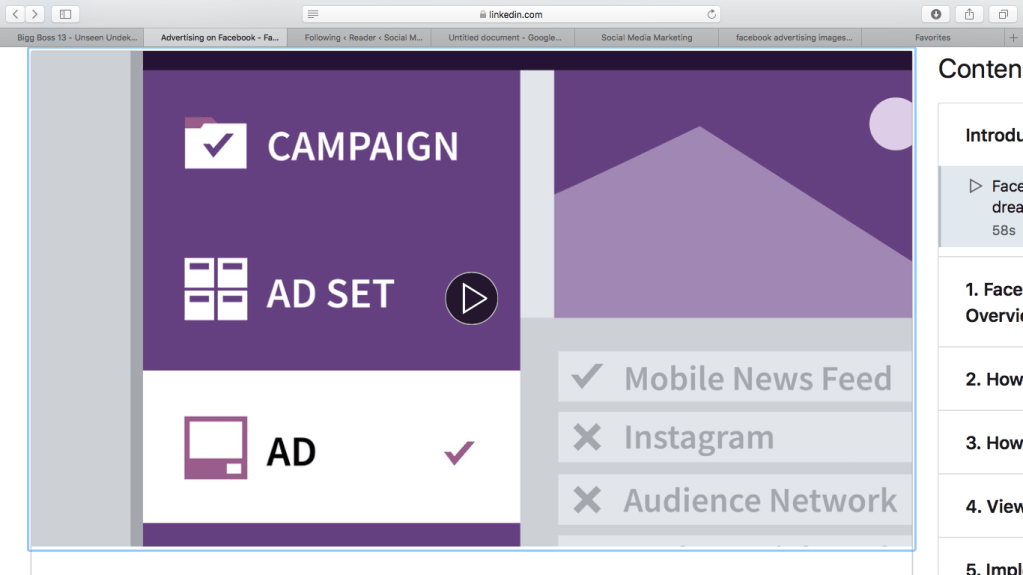
It is important to learn how these ads work, Adams (2019), has mentioned about ad guides in her video. According to her ad guide outlines different ad types, their purpose and even shows how these ads look. There are three main section on this Facebook page which are as follows:
1) Campaign– It defines your primary objective. Which can be further described as follows:
Awareness -Brand awareness and Reach
Consideration – traffic, engagement, app installs, video views (facebook pixel- tracks number of visitors)
Conversion– conversions, catalog sales, store traffic
2) Ad Set– determine the audience and placement of ads, who are you targeting? There are option to choose from your target audience. It is crucial to select your appropriate audience.
3)Ad – This section includes creating the ads itself, which can have images, text, videos, links to another websites etc.
Target Ads on Facebook
On Facebook, there are a lot of options to select your targets for your advertisement. Facebook collects a lot of information from its users that is then used to target audience in various ways. Some factors are involved in it which are described as follows:
Locations for business- Cities, countries, and neighbourhoods
Demographics- Age, gender, education
Interests- hobbies, or pages liked on fb
Behavior- purchase habits, device used or recent life events
Connections-Reach people connected to your page, applications, friends
Custom audience- use a customer contract list, your website traffic, or activity from your app
Sharing a customized add to existing users just upselling
How to create Facebook Ads
There are few different sections which were described in the video by Adams (2019), which are as follows:
A) How to set up an account: This section includes setting up a basic account first and then navigating through all settings.
Add Credit card for payment
Business name and add location of a country
Clarify Ad agency or working on behalf of anyone else
Facebook billing- payment methods, cap at spending to control ad cost
Email Notification -helpful if you are new user
Could be most difficult to set up account
B) Identify your Audience: Before advertising about your products, it is necessary to select your target audience first. Set up age, gender, location, language, and there is limited options to select cities but selecting a country is mandatory. There are two main type of audience which are described in the video.
Highly relevant audience
Target Intended audience
Refine your audience with interest targeting
Refine your audience with behaviour targeting, which includes– demographics, shopping habits, travel, additional behaviour option to select from.
Choose a budget for your ads
Start small in the beginning– There is budget option under the tools to manage and control your budget.
Cost control option- This is an option to control cost and there is info icon to get more information about cost controlling.
Budgeting and Scheduling- There is an option to set budget and schedule spending with the options of daily and lifetime spending budget.
View Your Advertising Data
Creating advertising reports
Reporting section- Under report section you can export table data as an excel file, can choose create reports option and also can compare attributes window.
Understand your success metrics, and do a comparison between different campaign using different factors. Tips for writing a great ad
a clear call to actions- make it easy for audience (adding weblink)
Use simple, eye catching images
have someone else review your ad
test and run multiple variations
Implement Best Practices
How to choose an effective image for your ad: Following are some of the tips mentioned in the video by Adams, (2019):
Try stock photography -pixle.com, unsplash.com are possible options
use images featuring people and bright colors
consider how the image will look when the size is reduced
test your images- discover which images your audience would prefer and work best
don’t underestimate the power and importance of the right image
Improve the performance of your ads
Are they relevant? Target interest, behaviour, demographics
Create a landing page-are you sending people to a specific page?
Analyze reporting data- get familiar with your cost per click, impressions, and reach.
Target specific device users- mobile friendly Are your ads running too often? Keep refreshing and improving
Conclusion
Overall, in this video by Adams, we got to learn about the usefulness of advertising on Facebook. The speaker talked about basics to teach his listeners about how to setting up your account and then went in dept about managing your account and some basic policies & procedures. Personally, i found some interesting ads over the years on my facebook page, although i never bought anything after getting influenced by those ads.
However, I find it interesting that how people especially the businesses are using social media such as Facebook to advertise their products or business as facebook is meant for people to connect with their friends worldwide. Eventually, i got to learn a lot about how i can use a social media site to advertise.
Copywriting according to wikipedia is defined as “Writing copy for the purpose of advertising and marketing”. The main intention of the copy writes is to sell, and call for an immediate action of it’s audience. In the video Ian Laurie, “It delivers value to people when they most need it”.
Different types
Brochures– these briefly explain about an organization or product, great as a “leave behind”s and encourage for a “call to action” (Lurie, 2014).
One-Liners– works best for business cards, banners, and social media marketing (Lurie, 2014).
Posters– short, brief and encourages viewer’s to find out more information by going to the website or contacting the organization (Lurie, 2014).
Direct MarketingPiece -a single call to action, focus on “pitch” and target new and old customers (Lurie, 2014).
Script-It drives audio, video, and animation (Lurie, 2014).
Product Description– describes what you are selling and used in the buying process (Lurie, 2014).
Process of Copywriting
Ian Laurie has explained his viewers what is copy writing and how to prepare before writing. There are few key elements to copywriting which includes delivering significance, persuasive writing, and visually appealing (Lurie, 2014). It is necessary to understand the target audience before writing any copy for marketing as these marketing copywriting are to promote and sell some products. Product description is mostly done when customer is in buying process (Lurie, 2014).
You need basic tools before starting writing such as timer, water, a proper software/gadget, and back up/storage (Lurie, 2014). Moreover, a right mindset to prepare yourself to write is necessary as it gives you positive and good start. After that you need to plan, which includes making notes about audience, list of collateral, list of styles that you want to use (Lurie, 2014). Then start with free writing and put your ideas on the paper without erasing it. This will give you content, a broader vision as well as new ideas.
It is also important to take breaks in between to keep the energy and excitement high. Try to finish big chunks or sections in one sitting. This will be your first draft one you done with main sections, review it and make sure you are not missing out any important information. Lurie (2014), encourages to do the introduction and conclusion at the very end as these two need to based on the main body/content. The speaker also talked about general rules of copywriting such as addressing the reader, quality of content, not to use sarcasm, also the importance of headlines.
Rewriting Existing Copy
Rewriting an existing or someone else’s copy is just like giving someone second opinion or view point and the main reason behind it to make improvements without actually restructuring the whole content (Lurie, 2014). Ian Laurie has provided some tips to make this rewriting most impactful and to make this happen, a good writer can ask for details and context about the topic to get some insights. Some of the good tips from the video are, looking for some unessential words to make the copy concise, making some edits to convert passive to active voice, and finally proofreading (Lurie, 2014). The speaker also talked about the typography and its impact as it makes it easier to understand the content and also the point of view of the designer (Lurie, 2014).
Conclusion
To become a good copywriter, first it is important to become a critical reader. Ian Laurie has described a critical reader as someone who understand, interpret and respond to things accordingly (Lurie, 2014). To provide an applied example of how to implement an idea from the summary, the preparation of writing part would fits here properly. Writing is an art and one has to prepare his mindset before starting to write. Furthermore, making time slots to write and taking breaks in between and making sure to finish a chunk of a section in that allocated time frame is a big start of becoming a copy writer. Starting with free writing and then writing first drafts are the important steps of this writing stage and also the importance of headlines (Lurie, 2014). To conclude, Ian Laurie has demonstrated basics to advanced level and tips of marketing copywriting in a very simple but exemplary way.
References
Lurie, I. (2014, May 30). Learning to Write Marketing Copy.
This is the first post on my new blog. I’m just getting this new blog going, so stay tuned for more. Subscribe below to get notified when I post new updates.
This is an example post, originally published as part of Blogging University. Enroll in one of our ten programs, and start your blog right.
You’re going to publish a post today. Don’t worry about how your blog looks. Don’t worry if you haven’t given it a name yet, or you’re feeling overwhelmed. Just click the “New Post” button, and tell us why you’re here.
Why do this?
Because it gives new readers context. What are you about? Why should they read your blog?
Because it will help you focus you own ideas about your blog and what you’d like to do with it.
The post can be short or long, a personal intro to your life or a bloggy mission statement, a manifesto for the future or a simple outline of your the types of things you hope to publish.
To help you get started, here are a few questions:
Why are you blogging publicly, rather than keeping a personal journal?
What topics do you think you’ll write about?
Who would you love to connect with via your blog?
If you blog successfully throughout the next year, what would you hope to have accomplished?
You’re not locked into any of this; one of the wonderful things about blogs is how they constantly evolve as we learn, grow, and interact with one another — but it’s good to know where and why you started, and articulating your goals may just give you a few other post ideas.
Can’t think how to get started? Just write the first thing that pops into your head. Anne Lamott, author of a book on writing we love, says that you need to give yourself permission to write a “crappy first draft”. Anne makes a great point — just start writing, and worry about editing it later.
When you’re ready to publish, give your post three to five tags that describe your blog’s focus — writing, photography, fiction, parenting, food, cars, movies, sports, whatever. These tags will help others who care about your topics find you in the Reader. Make sure one of the tags is “zerotohero,” so other new bloggers can find you, too.











 Social Media Marketing